
Physiotherapists and physiotherapy technologists (Phys. T.) are the two types of health professionals who work in physiotherapy.
In Quebec, these are the only two types of physiotherapy professionals recognized by the professional system. They treat physical disabilities and impairments and work to restore your full range of motion so you can go about your daily life. Physiotherapists and Phys. T. also help people manage pain, prevent injuries, work to educate the public, and promote health.
A new professional title
The professional title physiotherapy technologist (Phys. T.) replaced the former title physical rehabilitation therapist (PRT) as of September 2020. More information
Physiotherapists
Physiotherapists work with patients of all ages who have problems with their muscles, bones, joints, neurological system (brain, nerves, spinal cord), respiratory system (lungs), circulatory system (blood vessels), or cardiac system (heart).
Physiotherapists have a deep understanding of how the human body works, so they can assess the nature and cause of your problem. They identify the problem by assessing your physical abilities, including your joint mobility, strength, muscle tone and endurance, reflexes, and posture.
After making a diagnosis, your physiotherapist will develop and implement a treatment plan to suit your needs. Physiotherapists can also give you helpful tips on posture and healthy living and show you exercises to improve your physical fitness
Choosing a career as a physiotherapist
Physiotherapy: An essential part of Quebec’s healthcare system
Whether helping patients recover, relieving pain or preventing injuries, physiotherapists play a vital role in public health.
Overview of the profession and its future prospects
- What conditions do physiotherapists treat?
- What does their work involve?
- What are the different practice settings?
- What are the main reasons people seek physiotherapy?
- What qualities and skills are required, and what personality traits are associated with the RIASEC profile?
- Which universities offer programs?
- What are the salary ranges for this healthcare profession?
Explore the profession of physiotherapist
In french only
How do you become a physiotherapist?
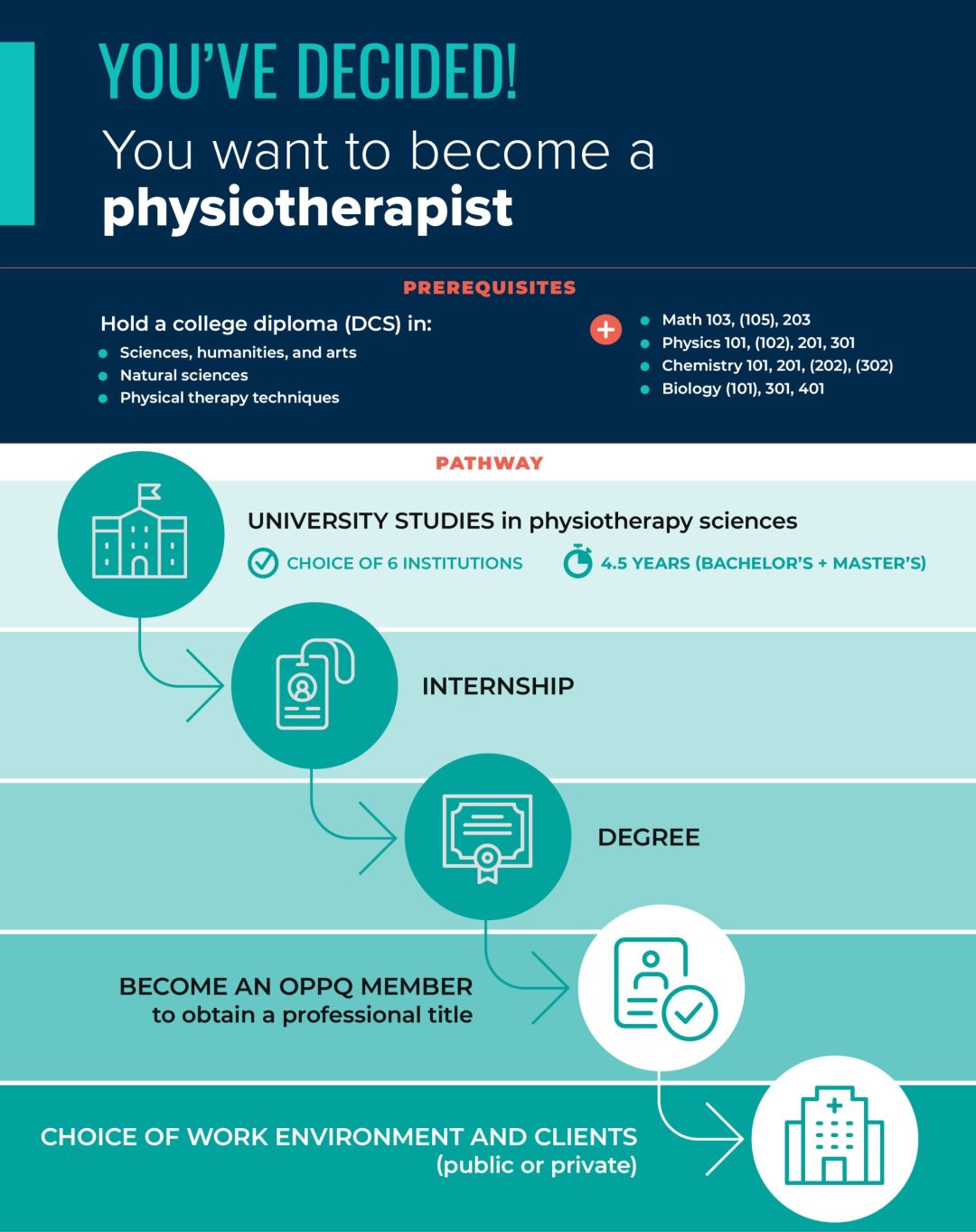
To become a physiotherapist, you need a master’s degree in physiotherapy from a Canadian university. To practise in Quebec, you also need to become a member of OPPQ and speak enough French to effectively practise the profession.
Six universities in Quebec have a physiotherapy program:
- Université Laval
- McGill University
- Université de Montréal
- Université du Québec à Chicoutimi
- Université du Québec à Trois-Rivières
- Université de Sherbrooke
What about graduates from outside Canada?
People with degrees from outside of Canada must apply to have their degree or training recognized before they can practise physiotherapy in Quebec. For more information on applying for equivalency, visit the “Become a Member” section
Did you know?
You don’t need a prescription or doctor’s note to see a physiotherapist.
A video is worth a thousand words
Watch profiles on Marie-Ève, a physiotherapist at Hôpital de l’Enfant-Jésus; Jean-François, a physiotherapist at the Apex Physio in Montcalm; Raymond, a physiotherapist at Clinique Stadium PhysioOstéo; and Julie, a physiotherapist at INS Québec’s sports medicine clinic.
Did you know?
Before 2009, you did not need a master’s degree in physiotherapy to become a physiotherapist. You only needed a bachelor’s degree.
We’re looking for skilled professionals!
Since physiotherapy is always evolving, professionals need to continually update their expertise and skills through continuing education and research activities.
These skills and expertise make them an effective and indispensable part of our healthcare system.
Physiotherapy technologists
Physiotherapy technologists (Phys. T.) work with patients of all ages, including athletes and people injured at work. They deal with problems affecting muscles, bones, joints, the neurological system (brain, nerves, spinal cord), the respiratory system (lungs), the circulatory system (blood vessels), and the cardiac system (heart).
Like physiotherapists, the primary objective of Phys. T. is to help you get back on your feet and regain your independence as quickly as possible.
Phys. T. step in after a physiotherapist or physician has assessed a patient’s condition. They collect and analyze the information on the patient’s chart in order to develop, implement, and monitor the treatment plan. Phys. T. can also give you helpful tips on posture and healthy living and show you exercises to improve your physical fitness.
Choosing a career as a physiotherapy technologist
Physiotherapy: An essential part of Quebec’s healthcare system
Whether helping patients recover, relieving pain, or preventing injuries, physiotherapy technologists play a vital role in public health.
Overview of the profession and its future prospects
- What conditions do physiotherapy technologists treat?
- What does their work involve?
- What are the different practice settings?
- What are the main reasons people seek physiotherapy?
- What qualities and skills are required, and what personality traits are associated with the RIASEC profile?
- Which colleges offer programs?
- What are the salary ranges for this healthcare profession?
Explore the profession of physiotherapy technologist
In french only
How do you become a physiotherapy technologist?
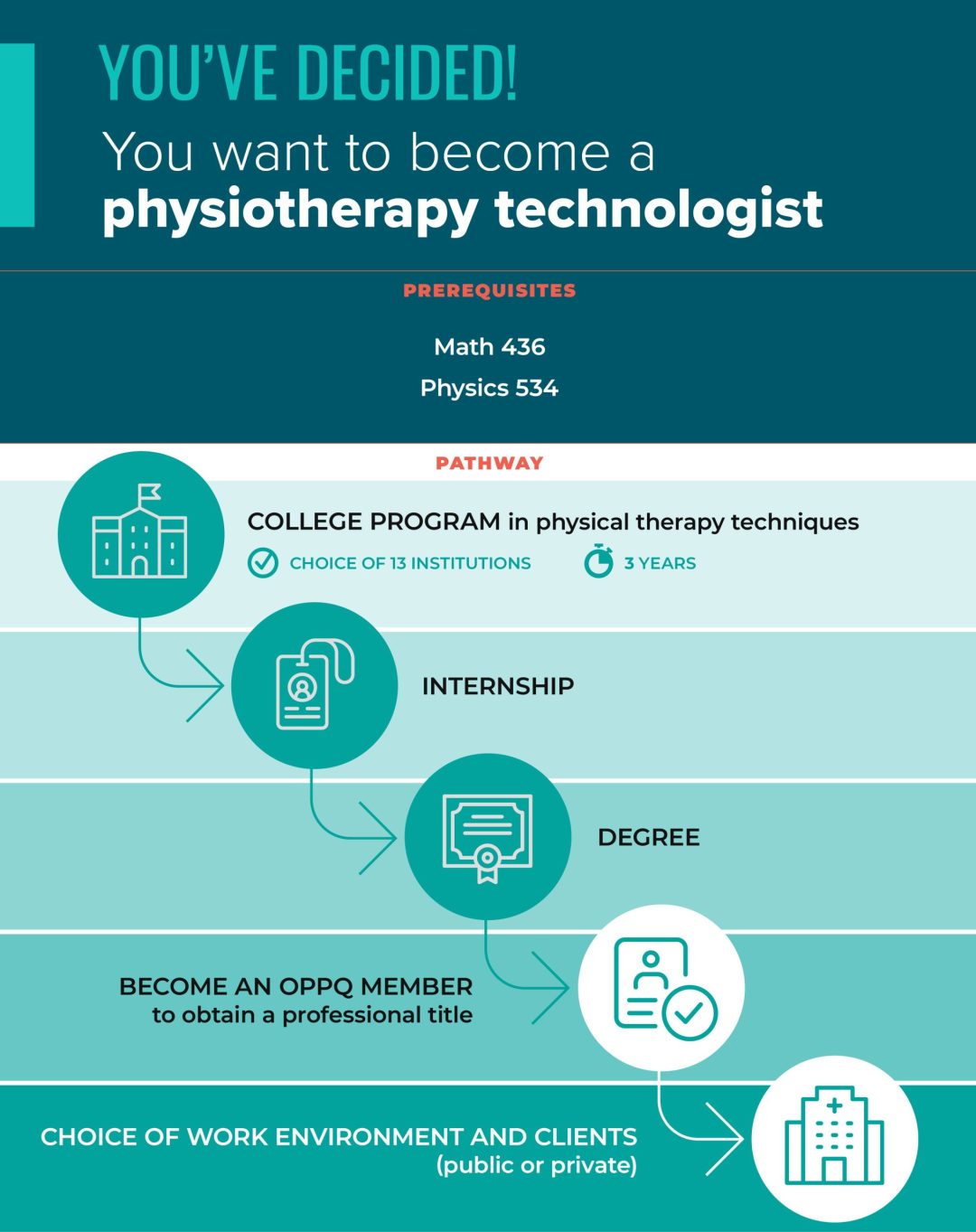
To become a physiotherapy technologist, you need a diploma of collegial studies (DEC) in physiotherapy techniques from a Quebec cégep. To practise in Quebec, you also need to become a member of OPPQ and speak enough French to effectively practise the profession.
Thirteen cégeps in Quebec offer a Phys. T. program:
- Cégep de Chicoutimi
- Cégep Garneau
- Cégep de l’Abitibi-Témiscamingue
- Cégep Marie-Victorin
- Cégep de Saint-Jean-sur-Richelieu
- Cégep de Saint-Jérôme (Centre collégial de Mont-Tremblant)
- Cégep de Sept-Îles
- Cégep de Sherbrooke
- Cégep de Valleyfield
- Cégep de Matane (campus du Centre matapédien d’études collégiales)
- Collège Dawson
- Collège Ellis
- Collège Montmorency
- Cégep de l’Outaouais (September 2027)
For more information, read our pamphlet on physical rehabilitation therapy.
What about graduates from outside Canada?
People with degrees from outside Canada must apply to have their degree or training recognized before they can practise physical rehabilitation therapy in Quebec. For more information on applying for equivalency, visit the “Become a Member” section.
A video is worth a thousand words
Watch profiles on Geneviève, a Phys. T. at Centre hospitalier universitaire de Sherbrooke; Francine, a Phys. T. at CSSS Thérèse de Blainville; and Nadine, a Phys. T. at Hôpital Jean-Talon.
We’re looking for skilled professionals!
Since physiotherapy is always evolving, professionals need to continually update their expertise and skills through continuing education and research activities.
These skills and expertise make them an effective and indispensable part of our healthcare system.